
Buying a fixer upper has always been a tried and true way to get into real estate.Buy the ugly house. Put some money into it. Build sweat equity. End up with something worth more than you paid.That

Dated: December 16 2025
Views: 131
Buying a home today isn’t impossible — but it does require a smarter approach than it did a few years ago. Interest rates, tighter affordability, limited inventory, and cautious sellers mean buyers need to be strategic, prepared, and realistic.
As a Realtor and investor who works with buyers every day, I see the same mistakes repeatedly. These missteps don’t just create stress — they can cost buyers tens of thousands of dollars, missed opportunities, or worse, a deal that falls apart.
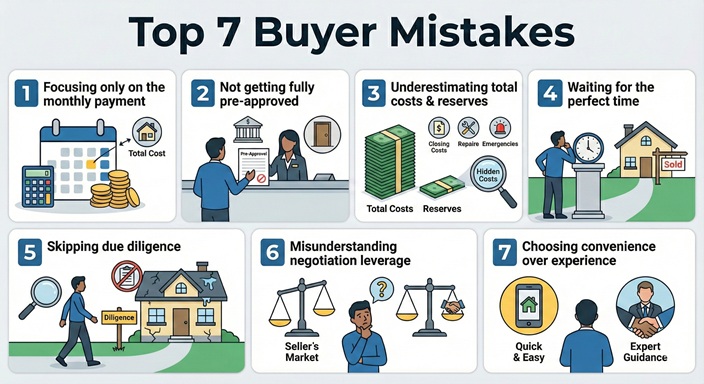
Here are the Top 7 buyer mistakes I see most often — and how to avoid them.
Monthly payment matters — but it’s not the whole picture.
Many buyers get tunnel vision on:
“What’s my payment?”
“How low can I get it?”
Instead of looking at:
Purchase price
Interest rate
Loan structure
Closing costs
Long-term equity
Resale value
Stretching for a payment you’re barely comfortable with limits flexibility and increases stress. A strong buying strategy balances payment, price, and long-term financial impact.
A pre-approval is not the same as a pre-qualification.
Buyers who start touring homes without a solid pre-approval often:
Lose out in multiple-offer situations
Miss deadlines
Discover lending issues late
Waste time on homes they can’t buy
In competitive situations, sellers prioritize buyers who are financially ready and vetted. A strong pre-approval — ideally from a responsive, local lender — can be the difference between winning and losing a home.
The purchase price is just the starting point.
Buyers often budget for the down payment — but forget about closing costs and post-closing reserves, which are just as important.
Lender origination and underwriting fees
Appraisal
Credit report
Title insurance
Escrow fees
Recording fees
Prepaid property taxes and insurance
HOA transfer/setup fees (where applicable)
After closing, buyers should still have:
Emergency savings
Funds for maintenance and repairs
Cushion for unexpected expenses
Flexibility if life or employment changes
Homes are long-term commitments. Entering ownership with no reserves increases stress and limits options if something unexpected happens.
Trying to time the market perfectly is one of the most common — and costly — mistakes. I can't tell you how many people I heard back in 2015-2018 say, "I'm waiting for the market to crash"...
Markets move in cycles. Rates fluctuate. Inventory changes. What matters most is whether:
The payment fits your budget
You plan to stay long enough to ride out cycles
The home fits your needs
Your finances are stable
Waiting for perfect conditions often means missing good opportunities that were available right in front of you.
In competitive markets, buyers sometimes feel pressure to:
Waive inspections
Ignore red flags
Rush decisions
This can backfire quickly.
Strong buyers protect themselves. Inspections, disclosures, and professional guidance exist for a reason. Short-term wins can become long-term headaches if you cut corners.
Negotiation isn’t just about price.
Leverage can come from:
Inspection terms
Closing timelines
Financing strength
Seller motivation
Repair credits
Appraisal strategy
Buyers who focus only on purchase price often miss opportunities to improve terms or reduce risk elsewhere.
Many buyers work with the first agent they:
Click on online
Get assigned through a platform
Are referred to without vetting
That doesn’t mean the agent is bad — but real estate is an experience-based business.
A strong buyer’s agent brings:
Market knowledge
Pricing insight
Contract expertise
Negotiation skill
Risk management
Clear communication
The right agent doesn’t just open doors — they protect you and guide you through one of the largest financial decisions you’ll make.
“I need 20% down.” Not true. There are 0% down VA and USDA loans or 3.5% FHA Loan products.
“New construction is always more expensive.” Not necessarily when accounting for lender incentives.
“I’ll refinance later, so the rate doesn’t matter.” Risky assumption. We're not likely to see sub 3% rates for decades... if ever.
“I can figure this out as I go.” Costly approach that can cause you to miss 'the one' or buy the wrong 'one'.
Assumptions like these can cost buyers money or cause them to wait to buy.
If you’re also thinking about selling — or want to understand what sellers are prioritizing right now — check out my related post:
Top 7 Mistakes Sellers Make in a Shifting Market
Understanding both sides of the transaction helps buyers negotiate smarter and avoid unnecessary friction.
Buying a home is one of the biggest financial decisions most people ever make. Avoiding these mistakes doesn’t require luck — it requires preparation, clarity, and experienced guidance.
Informed buyers make better decisions and build long-term stability.
If you’re planning to buy in the next 6–12 months and want a clear strategy — from financing to negotiation — I’m always happy to help you understand your options and avoid these common pitfalls.
Jordan Ames
Realtor® | Real Estate Investor
Northern Nevada & Tahoe

With over a decade of experience in the Northern Nevada real estate market, I bring a wealth of knowledge and expertise to every transaction. I have helped over 300 clients buy and sell homes, and I p....
Buying a fixer upper has always been a tried and true way to get into real estate.Buy the ugly house. Put some money into it. Build sweat equity. End up with something worth more than you paid.That
Here's your September 2026 Real Estate Market Report for Northern NV!Make sure to check out the coupons from some great local vendors who have agreed to offer discounts to my clients!
Buying or selling real estate is exciting, but it also involves something that attracts scammers: large amounts of money changing hands.Unfortunately, criminals have become increasingly
A major milestone in U.S. housing policy has officially arrived.The 21st Century ROAD to Housing Act (H.R. 6644) has become law after passing Congress with overwhelming bipartisan support.
 The data relating to real estate for sale on this web site comes in part from the Broker Reciprocity program of the Northern Nevada Regional Multiple Listing Service®. Real estate listings held by brokerage firms other than the owner of this site are marked with the Broker Reciprocity logo and detailed information about those listings includes the name of the listing brokerage. Copyright 2026 of the Northern Nevada Regional Multiple Listing Service MLS. All rights reserved.
